Taipei's Energetic Mornings
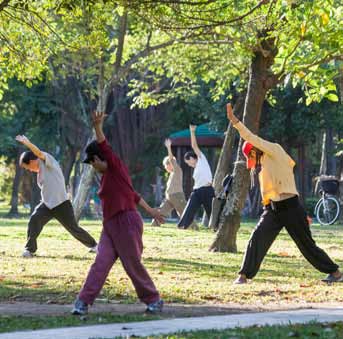
The majority of the early-morning exercisers you’ll see are seniors, and each practitioner has his or her own unique skills. The forms of shadow boxing that you’ll see involve deft swinging movements that seem mechanized, but require practiced control and are majestic and imposing. Shuai shou gong (甩手功) , which evolved over thousands of years, is an adaptation of the yi jin jing (易 筋經) developed at China’s famed Shaolin Temple (少林 寺). Yi jin means to temper and strengthen tendons by rhythmically swinging one’s arms in pendulum-like fashion, working the 12 tendons in the fingers, palms, and wrists down to the knees, heels, and toes. Through the easy method, the arms are swung from approximately 500 to 2,000 times each session. Over time the tendons are toughened, and the method is rumored to be an effective way to relieve lesions or minor injuries without medication. Another form with the same health benefits combines the toning of tendons with proper qi breathing. Qi (氣) is the life energy of the universe. Lajin qigong (拉筋氣 功) is different from ordinary stretching exercises and tendon toning exercises. The emphasis is on overall body equilibrium, combining deep, slow, measured breathing with stretching of the tendons and muscles in all body points, easing tension and bringing relaxation. The concept of qi is central to the Chinese world view, and it is believed that wushu study effectively combines exercise and qi regulation. The emphasis in both qigong and taijiquan is on qi regulation, inhaling and exhaling deeply with each step, the fists slowly pushing outward. Although each individual movement may not appear forceful or powerful, in fact each contains a strong surge of inner strength. Because the body remains soft and supple, many people mistakenly believe that taijiquan is a form of exercise exclusively for the elderly. The emphasis, however, is on inner consciousness, not external strength. The less power used, the more nimble one’s movements. And with continuous practice over the long term comes self-cultivation, calming the temperament. Today, more and more young people are taking it up. Serious martial arts can be extended into lively dances. In the city’s parks you’ll often see practitioners of yuanji dance, blending wushu, dance, music, qigong, massage techniques, and Kegel exercise. Practitioners take light dance steps, following the five-tone scale of traditional Chinese music (五音): gong (宮), shang (商), jue (角), zhi (徵), and yu (羽). They dance alone or in groups, and the form is suitable for males and females, young and old. In this relaxed, comfortable atmosphere dance becomes exercise. There is no demand for perfection in every movement, and the pleasant melodies get participants both in the mood and in the rhythm. The 12 sets of movements include numerous tiptoe, heel, and finger motions, helping to loosen joints and open what are called the body’s meridians. Yuanji dance is a fusion of entertainment and physical strengthening, and can be said to be the Chinese culture’s unique form of aerobic exercise. A visit to parks and community squares shows that folk dance is also very popular. Elements are taken from the life, culture, customs, rituals, and celebrations of common folk around the world. In Eastern folk dance there is a passion for combining dance and song, as well as for the use of various props, including fans, sleeves, handkerchiefs, tambourines, and decorated umbrellas. The song and dance tell the stories of peoples passed down since ancient times. Greeting the New Day With a Good Workout Teachers offer free instruction for most of the exercise types described above. If you’d like to join the early-morning exercisers, you’ll be warmly welcomed. However, if you perhaps find these forms a bit abstruse, why not try something that requires no memorization of steps – jogging. Each and every early morning, you’ll see parks both big and small busy with Taipei folk out pursuing fitness and relaxation. If you want to try your hand at different things, visit one of Taipei’s larger parks, which offer convenient transportation, diverse facilities, and lots of space, enabling various forms of recreation, including jogging. Especially good choices include the big squares on the grounds of National Dr. Sun Yat-sen Memorial Hall and National Chiang Kai-shek Memorial Hall, 2/28 Peace Park (二二八和平公園), Xinsheng Park (新生公園), Youth Park (青年公園), Daan Park (大安森林公園), Dahu Park, and Nangang Park (南港公園). Other spots where you can get a look at Taipei’s denizens engaged in healthy, dynamic early-morning action are the riverside parks that circle the city core and the many community neighborhood parks.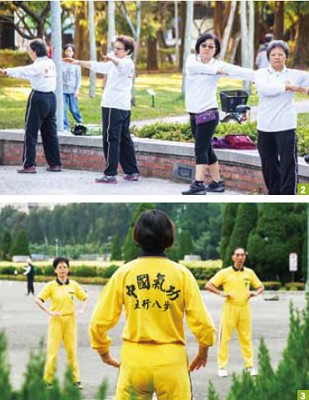 Traditional Wushu – Imposing Moves
 Qigong is the foundation for most forms of Chinese wushu (武術), or martial arts. There are three basic elements: regulating the mind, regulating the breath, and regulating the body. Practitioners must first eliminate any distracting thoughts, then engage in measured breathing using the lower part of the abdomen, and finally try to relax the entire body, allowing the four limbs to freely follow spontaneous movements in order to conduct the flow of inner qi, promoting peripheral blood circulation, and helping to get rid of built-up waste.
 The Local Color of Folk Dances
 The fan dance is especially distinctive. It originated as an ancient Korean sorceress blessing ceremony, and afterwards slowly evolving into a folk dance. During a formal stage performance, dancers wear brightly colored, loose-fitting garments, hold elegant fans with long silk ribbons, constantly change movements in keeping with the changing rhythms of the gentle melodies, and bring masses of fans together in lyrically colorful patterns and shapes, creating aesthetically pleasing visual effects. Though the attire worn in public parks may not be so splendid, the delicate motions, sedate mannerisms, and elegantly feminine postures and movements clearly reflect the ladies’ focus and long hours of practice.